Memories of another fun getaway!
- Tammy


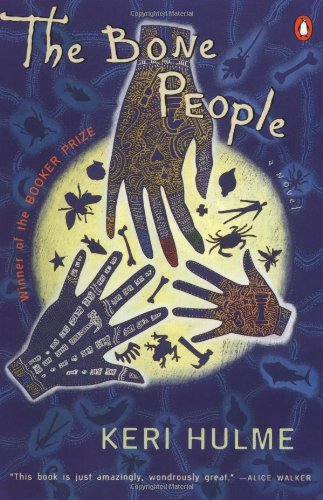
"It is beautiful and terrible. It is tender and cruel. It is dream and reality. It is poetry and crudity. It is infinitely simple and infinitely complex." New Zealand HeraldI warned you it wouldn't be an easy read...but I hope you persevered! In the notes at the start of The Bone People, author Keri Hulme issued both a caution, a guide of sorts, and a ray of hope to her readers. It intrigued me and made me want to discover how I felt about "kina roe".
"I live five hundred miles away, don't have a telephone, and receive only intermittent mail delivery – so consensus on small points of punctuation never was reached. I like the diversity.
The editor should have ensured a uniformity? Well, I was lucky with my editors, who respected how I feel about... oddities. For instance, I think the shape of words brings a response from the reader -- a tiny, subconscious, unacknowledged but definite response. "OK" studs a sentence. "Okay" is a more mellow flowing word when read silently. "Bluegreen" is a meld, conveying a colour neither blue nor green but both: "blue-green" is a two-colour mix. Maybe the editors were too gentle with my experiments and eccentricities. Great! The voice of the writer won through.
To those used to one standard, this book may offer a taste passing strange, like the original mouthful of kina roe. Persist. Kina can become a favourite food."Indeed.
"I don’t know why The Bone People was so successful. People enjoy it (and strongly dislike it) for different reasons. It spoke to some people’s Maori-ness. I think that its compassion for deeply damaged people is important; it gives space for readers to reflect on the pain in their own lives, including the pain they’ve caused, and to imagine what might bring healing. I like it that it probably can’t be adapted for film, that the story stops there in the novel. I like the place of food in it. I’ve read it only twice, that first time, and when there was a seminar five years ago. I discovered then that I appreciated the structure better than I used to; I always found it seductive and satisfying, but now I understand how it works."
"They were nothing more than people, by themselves. Even paired, any pairing, they would have been nothing more than people by themselves. But all together, they become the heart and the muscles and the mind of something perilous and new, something strange and growing and great. Together, all together, they are the instruments of change."A story about personal relationships, characters facing personal crises, bring purified by suffering and at the end coming together in a new union. But the story can also be read as an allegory on the healing of past national wounds. Kerewin, Simon and Joe are 'the bone people'—the founders of a new way of living. (Evening Post, New Zealand) Reading reviews and discussions by New Zealanders gave me a greater appreciation for the layered meaning, the style of prose, and the intricate interweaving of Maori/pakeha lives, cultures, and families struggling and flourishing in New Zealand today. I'll share more on Thursday!
